Author: Bai Yazhou
If you are an old player like me who has watched football for more than 20 years and played the Football Manager (hereinafter referred to as FM) series for the same 20 years, you may have had mixed emotions when opening your Steam library in the past two years.
For a long time, FM has been a special game for a group of us: on the one hand, it has a somewhat “New Year’s product” feel, and on the other hand, it is dynamically closely linked with the real world, which is unique among simulation games. It can create a parallel universe that will accompany us through countless late nights, and it can also allow some “fans + players” groups to find additional narrative space.
But the reality is also a bit cruel. From the unprecedented cancellation of “FM25” to the word-of-mouth storm that “FM26” encountered after switching to the Unity engine last year, this always stable series has experienced an unprecedented transformation pain.
I still remember this time last year, among the old FM players around me, the most discussed topic was not which little monster was good, but the confusion about the new interface – the UI that was drastically revised for cross-platform unification made many people feel uncomfortable, and some familiar functions were put into the second and third level menu pop-ups. So much so that until not long ago, if I look at the “statistics around me”, there are still a large proportion of die-hard old players who stubbornly stay in the archives of “FM24” as “nail households”.
In a certain sense, Sports Interactive (hereinafter referred to as SI) is not a company resting on its laurels. What’s a bit amusing is that it was their desire for change that led to the controversy of FM26 last year. So this year, we stopped updating FM26 early, and faced players with the rare release strategy of “Free Launch Preview with no threshold for 5 days before release”. You can definitely feel their determination to face the setbacks. At the end of last month, several colleagues and I sat in front of the two main creators and chatted with them.
Later, I myself experienced the reconstruction and new model of this generation in depth. Now, I can finally give a definite conclusion to those old friends who are still watching “FM24”: The slightly long “running-in pain” has ended, and “FM27” may be a mature game that is truly worthy of old players packing their bags and “moving” back.
01 Confront the “elephant” in the room
Regardless of whether I play the game myself or in previous interviews, one of the most intuitive feelings is that the readability of the UI has finally improved. It is not a simple “change back”, but has finally solved some pain points.
The evolution of “FM27” cannot avoid last year’s “FM26” in any case. At the beginning of the interview, I directly asked the creative team “whether the past two years have been the most difficult time since the establishment of SI, and what was the biggest misjudgment the team made during the review.”
What surprised me was that SI’s design director Remy did not use diplomatic rhetoric to whitewash the situation, but very frankly admitted that the team had underestimated the initial stage of technological transformation: “Our most underestimated challenge in “FM26″ is indeed everything related to the user interface (UI) under the Unity engine. Our team of experts has been working on the self-developed engine for a full 30 years. It takes far more time and energy for everyone to completely adapt to a new tool chain and reconstruct the entire game than imagined.”
In “FM26”, the development team spent almost all their energy on “setting up the foundation in Unity”, thus making a design mistake in the interactive experience that was extremely painful for core players – confusing “Navigation” and “Information”.
Last year’s interface was filled with a large number of tiles. Players had to click on these cards to jump to pages and read data from these cards with a limited area. The result is that for veteran FM players who often need to compare dozens of player attributes, contract details, and tactical reports at the same time, the screen space is severely wasted, and the information that could have been scanned at a glance has become a cumbersome click and pop-up window.
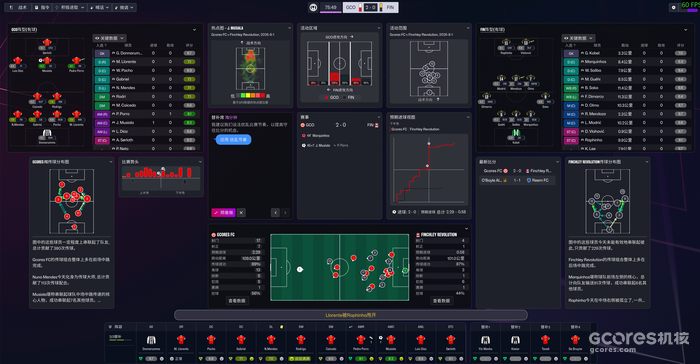
In “FM27”, when you enter the main interface of the club for the first time, the most intuitive sense of comfort comes from the adjustment of the underlying logic.
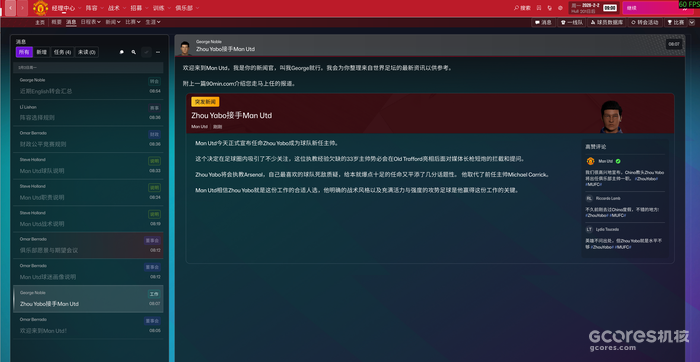
“We completely changed our design philosophy in “FM27″,” Remy explained to me in an interview. “We established the three principles of efficiency, predictability and familiarity. Now, all the main navigation bars are clearly gathered to the top of the screen; and all areas below the top navigation bar are returned to pure information display.”
What makes old players feel “breathing easier” even more is the return of full-screen high-density information flow. The core pages that were stuffed into cramped small pop-up windows in “FM26” – such as the “Player Progress Screen” in the player’s profile – are all restored to a complete and atmospheric full-screen view in “FM27”.
This means that you no longer need to search for data in the folding menu like doing an eye exam. The subtle rise and fall of each single attribute and the detailed analysis of the scouting report once again fill the screen in the most familiar and clear report form for veteran players.
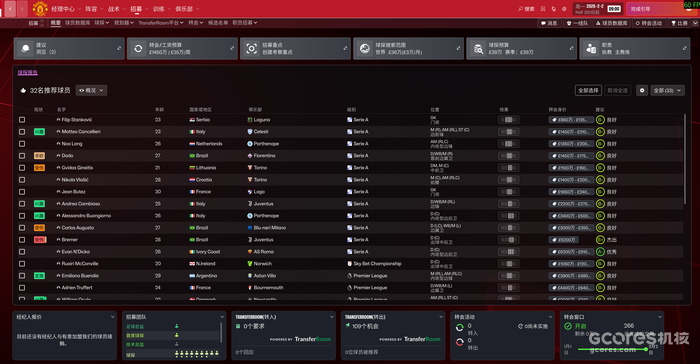
The return of the “top menu bar” even reminds people of earlier FM works. At least to me, the return of this design is quite consistent with the more basic logic of the FM series, and is even more intuitive than the sidebar.
There is another change that is very important to many people: in the preferences menu, SI finally returns the “Reload Skin” button that old players miss so much.
Although due to copyright compliance requirements, the official cannot publicly encourage third-party mods in a high-profile manner, the main creator showed a tacit smile in the interview: “Our position is never to cause trouble to the community. We know how much Chinese players and the global community like to play with avatar packs and custom skins. If we add this button back, everyone will understand what we mean.”
To a certain extent, this change in “table” is obviously the first reassurance that “FM27” gives to all returning old players.
02 A different “tactical master”
The changes in the watch world are obviously very intuitive. From the outside to the inside, the internal changes in this generation of FM are also very dependent on skill.
Players who are familiar with the FM community know that over the past many years, there has always been a love-hate phenomenon at the tactical level of the game: in the middle and late stages of each version, there will always be several sets of so-called “version god formations” circulated on the Internet (such as 4231 or 424, which are brainless and full of high-position pressing and high-tempo). Whether you are coaching Manchester City, Arsenal, or a grassroots team in League Two, as long as you introduce the divine formation, the team can often kill everyone. Although this lowers the threshold for fun play, it also greatly dilutes the sense of accomplishment in tactical training.
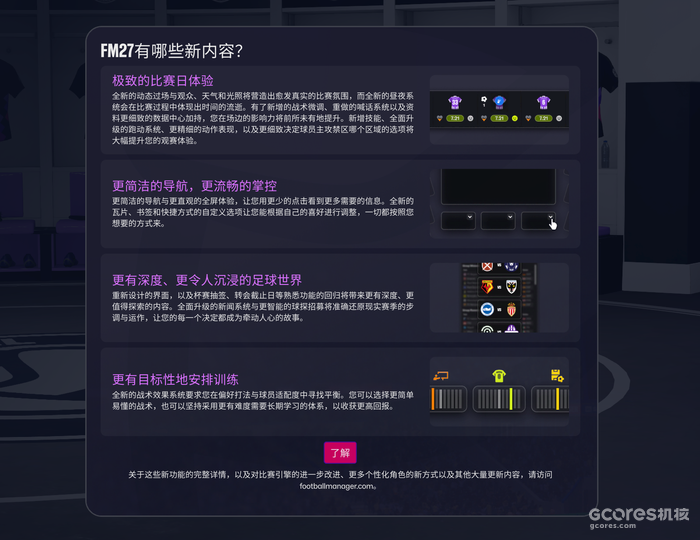
In “FM27”, SI performed a major operation on the “tactical familiarity” that has existed for many years, and comprehensively upgraded it to a more in-depth “tactical effectiveness (Tactical Effectiveness)” and “tactical complexity (Tactical Complexity)” system.
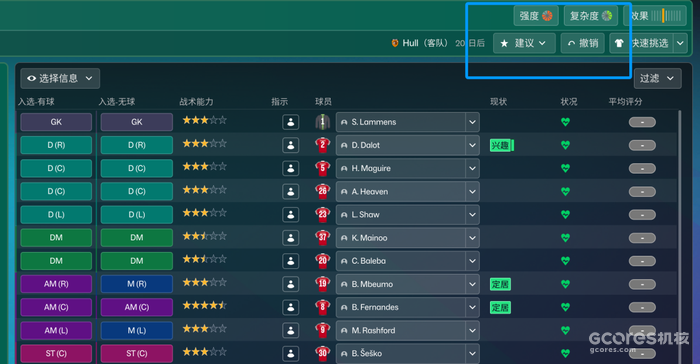
“In real football, the way you coach a Premier League giant is absolutely different from the way you coach a Sky Bet League Two team.” The creative team used an analogy when explaining the underlying logic of this new system. Obviously, high-dimensional tactics such as high-position pressing and short-pass penetration are actually difficult to play in lower-level leagues. If this can also be applied, it will obviously destroy the realism of some FMs.
In the past, tactical proficiency was just a progress bar that would be reached sooner or later over time; but in “FM27”, the more complex and sophisticated your tactical blueprint is, the more stringent the requirements for players’ golf IQ, technical attributes, and daily training.
If you insist on giving an extremely complex pass-control and position-changing tactic to a low-level league team, the players will not only be unable to cooperate on the court, but will make mistakes due to overloaded understanding. The introduction of this “asymmetry” is equivalent to fundamentally weakening the possibility of “one set of gods to dominate the world”, forcing players to truly think like a real head coach, “what kind of football is suitable for this group of players at hand.”
And when the opening whistle of the game actually blew, the power of the Unity engine, which had been accumulated for a year, began to show up on Match Day.
The first is the leap in visual and light and shadow dimensions. This generation introduces a new dynamic time and light and shadow system. The game will even calculate the position of the sun based on the true latitude and longitude coordinates of the stadium on the earth. Even if the game kicks off at 3 p.m., the bright sunshine in mid-summer August and the long shadow cast diagonally on the turf in late winter will present a completely different stadium atmosphere. Together with the new physical effects of weather, the game will be full of immersion.
What’s more important is the real sense of commanding from the sidelines. Based on the reintroduction of “Shouts” in “FM26”, “FM27” not only optimizes the logic of the real impact of shouts on players’ body language and on-field behavior, but also adds a very convenient “Real-time Tactical Tweaks” function.
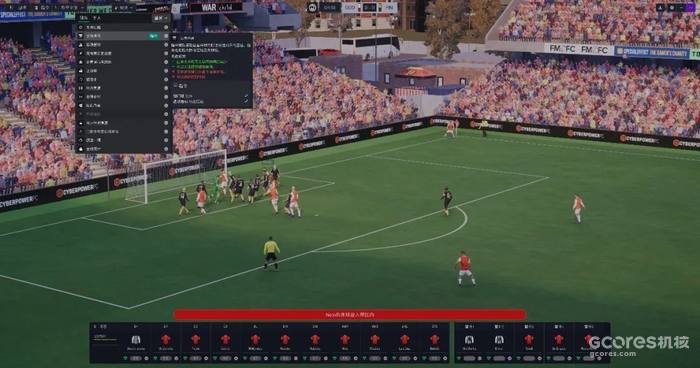
In the ever-changing 90 minutes, when you find that your opponent is pressing too hard on the wing or your own defense is tight, you no longer need to pause the game and click on the huge and complex tactical board to fight as before. Instead, you can directly complete targeted tactical disruption (Disruption) through quick instructions on the sidelines and engage in real-time psychological games with the opposing head coach.
This kind of game system will tell you its advantages and disadvantages, unlike some previous versions, which can bring out the green status of some players by simply doing some “micro-management”. Obviously, this is still for the purpose of immersion.
03 “Online Draft” is so fun
In fact, the fun of this generation of FM is not just the previous “researching Excel sheets”. In terms of the gameplay itself, the return of “Online Draft (Draft/Shuffle Draft)” after the redesign has even turned FM into a game with gameplay.
To be honest, although the traditional FM career mode is charming, it is too “heavy” – it often takes several hours just to set up a database, clean up redundant personnel, and build a scouting network, which is not conducive to newcomers entering the game. The new draft mode provides a “short, flat and fast” cut that is extremely light and full of gaming pleasure.
This is a bit gratifying to me: Although SI has understood before that the FM series is too vertical and difficult to get into, their overly radical reforms in the UI in the past two years are actually in the wrong direction. Newcomers may not buy it, but the “fun” mode of online draft may really stimulate the interest of new and old players from all walks of life.
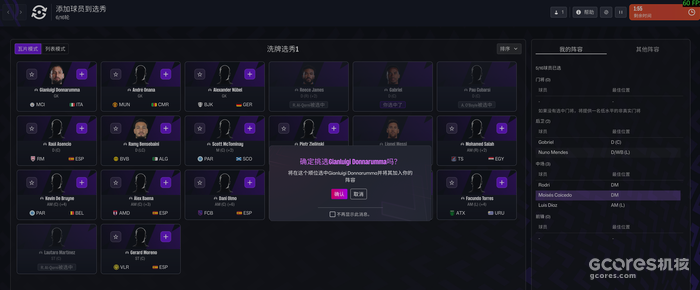
In a nutshell, the draft mode is a bit like drawing cards in Magic: The Gathering. Whether it’s a solo challenge or an online connection with three or five friends, under the rules of the shuffle draft, you no longer have a ready-made wealthy team. Instead, you need to observe the opponent’s intention to acquire players in a draft pool full of variables, while piecing together the lineup round by round around your favorite tactical core.
When those stars who would never be in the same league in the career mode due to sky-high transfer fees or the attributes of rivals, put on the same jersey under your careful budget and immediately engage in high-intensity tournament battles, the sheer fun of lineup building and horse-catching effects are even more addictive than traditional leagues.
At the meeting at the end of October, I and two other players had a Draft battle with SI’s Remy with Premier League players as trump cards. In the end, my combination of Odegaard + Isaac lost to Remy with Rice and Saka, and Remy himself lost to another player with Haaland and Van Dijk.
What I have to mention is that the huge parallel universe of football is also becoming more full.
This year, SI not only won new official licenses from the Saudi Professional League and the French Women’s Top League, but also accurately synchronized the latest rule changes in real football – such as FIFA’s latest stipulation that “the coaching staff of the women’s national team must have a minimum proportion of female staff” – to the bottom of the game.
The creator even revealed to us a rather astonishing statistic: In the previous generation of games, more than8.9 million archivesBoth men’s and women’s football leagues are loaded. Because for many old players who are used to “memorizing the list of monsters from all over the world” in the men’s football giants, going to a field they are not so familiar with to “blind box gold panning” purely relying on scouting reports and trial training has brought back the fun of exploration that they had when they first came into contact with FM twenty years ago.
04 Submit your certificate of nomination using “Free Trial”
At the end of the interview, I asked the two creators a question: “In the face of those die-hard old players who are still playing “FM24”, if you can only use the most concise words to persuade them to take this step and try “FM27″, what would you say?”
The two creators looked at each other and smiled, and gave an almost unanimous answer: “Don’t listen to what we say, go and try it yourself.”
This is the reason why “FM27” launched a “5-day full-featured free early access” on the eve of its release and continues to provide free demos on Steam. In sports games and even the entire buyout game industry, it is undoubtedly a very courageous “naked test” to dare to release the complete official version without any pre-order threshold in the second year after experiencing a reputation storm, so that discerning players around the world can “Try before you buy.”
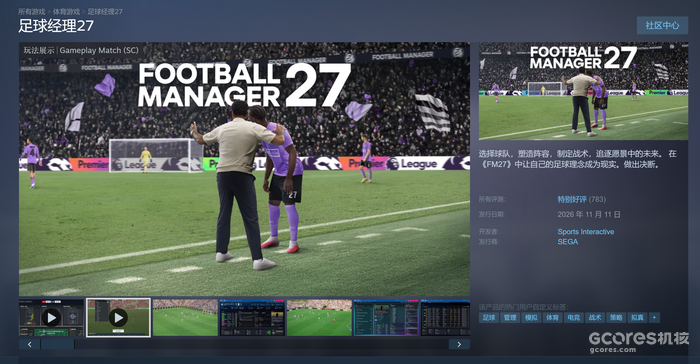
The reason why SI dares to do this is because they know in their hearts: after a whole year of listening, reflection and polishing, the “Football Manager” familiar to old players, rigorous, and making people unknowingly wake up as soon as they sit in front of the computer, has truly come back – on November 11, the game’s praise rate reached 91% on the day of release. After last year’s controversy, we can finally say this.
In general, if you still deeply love the thrill of strategizing on the virtual green sidelines, and if your legendary coaching resume stuck in 2024 has become dusty, then now, it is time to open “Football Manager 2027” and start the next phase of your coaching life.