Welcome to the Conversation
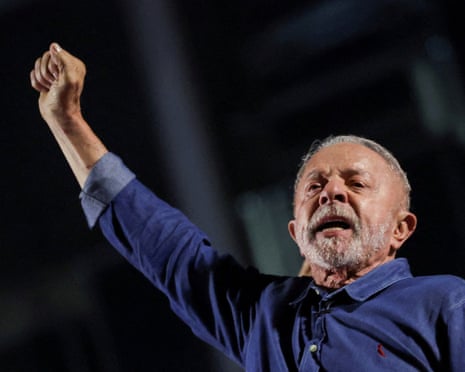
After losing the first round of Brazil’s presidential election to far right rival Flávio Bolsonaro, incumbent Luiz Inácio Lula da Silva, better known simply as Lula, pulled off the most stunning political fightback in modern Brazilian history by winning the second, in so doing securing a fourth presidential term. It will see him become the country’s longest-serving leader.
The result – 51.79% to Lula, 48.21% to Bolsonaro – was delivered after a supreme court judge had extended polling time by two hours, and after Lula’s camp accused their opponents of sabotaging public transport in an attempt to keep their voters from the polls. It was the first time in Brazilian electoral history that a first-round verdict had been overturned.
But Bolsonaro, son of former president Jair Bolsonaro who is serving a 27-year jail term for his part in an attempted coup after the last presidential election, refused to accept the result – just as his father had done, four years before. He called Lula’s victory “sacanagem”, a Portuguese word that roughly translates as “bullshit”.
Brazil remains a deeply divided country and Lula will have to navigate a hostile Congress, packed full of Bolsonaro allies, if he is to make significant legislative changes in his fourth term. His options are also constrained by a gloomy economic outlook, with Brazil experiencing soaring debt and entrenched structural problems. As he turns 81, will the re-elected president have the energy to face down the far right opposition for another four years and to lay out the ground for a credible successor?
And what does Lula’s latest victory mean for the wider region, and for the country’s relationship with Donald Trump’s administration? In the Guardian’s Opinion pages columnist Jordana Timerman wrote that “Lula’s victory shows that the rightward shift is neither inevitable nor irreversible. But the movement retains substantial electoral support, influence over the political agenda and a powerful ally in Washington.”
The Guardian’s Latin America correspondent Tom Phillips will be answering your questions on the election result, what it means for Brazil and the wider region, and what the country’s future may hold, here from 15:00 GMT on Tuesday 27 October. Comment with your question below, or email conversations@theguardian.com

Key events
How can Brazil fight outside interference?
Patric Mauz says: How can Brazil ‘shore up’ the democratic process against outside influences? The natural resources that Brazil stewards is a massive amount and it is so very obvious that wealthy outside parties would very much like to have a say in that. Datacentres and natural resources are more important than the Amazon rainforest or local native tribes to those who have the wealth and power. It will only get worse and that is terrible for future generations.
Tom: I think the key answer to this question is in the first speech Lula gave after the result was announced on Sunday night. “This was an election in which we had to overcome outside interference, through digital platforms, which we are going to have to regulate,” Lula told us at the São Paulo hotel where he was following the vote count. “It is unacceptable that we don’t recognise that crimes committed in the digital world must be treated the same as real-life crime. We cannot have monstrously huge corporations making millions and billions, paying zero taxes in this country, and trying to steer the outcome of its elections,” Lula went on.
Clearly – not just in the lead-up to this election, but stretching back several years – social networks in Brazil and elsewhere – have been skewing their output in favour of far-right candidates and movements.
On the eve of Sunday’s vote, Meta was accused of actively trying to interfere in Brazil’s election in Bolsonaro’s favour – although it denied those claims.
One of Lula’s biggest – and most complex – tasks during his fourth term will be trying to tackle this problem.
Has Lula halted logging in the Amazon?
Haranf asks: Has there been a significant decline in logging and deforestation since Lula has been president?
Tom: Yes, there has been a historic reduction of deforestation, not just in the Amazon but also in the Cerrado savannah at the heart of Brazil. This has been the result of a major push by Lula’s government, under the leadership of former environment minister Marina Silva, who may now return to government having failed to win election to the senate. Lula’s efforts came after four years of destruction under Jair Bolsonaro, who governed from 2019 to 2022, and set about dismantling Brazil’s environmental protection agency, Ibama, and other efforts to protect the environment. Back then, environmental officials were effectively banned from talking to journalists like me. They were grim times for the environment.
When I spoke to Marina Silva on Sunday night she was overjoyed that Lula’s efforts to protect the environment could continue now he had secured a second term. “My heart is happy and filled with gratitude to God and the Brazilian people,” she told me. “The thing I most feared was that our Indigenous territories would be invaded again [under another Bolsonaro government]. Now, I am certain that they will be preserved and that there is no risk of illegal miners returning to destroy these populations.”
That is one of the most uplifting elements of Sunday’s result, I think, although things will not be easy going forward given the major expansion of the far right presence in Congress, which will make stripping away environmental protections easier. After the recent first round election, the Climate Observatory umbrella group warned that 64 of Brazil’s 81 senators and 345 of the 513 lower house lawmakers were now in some way hostile to environmental protection issues. So it’s going to be tough for Lula.
Has the football shirt been reclaimed from the right?
DapperDon asks: It seems to me that national football team colours have been hijacked in recent South American elections with conservative and rightwing candidates adopting team colours to claim patriotism. Arguably Bolsonaro Snr was one of the first to politicise national pride back in 2018, but it seemed not to have been as much of a factor in this election with Jnr. Are folk growing accustomed/cynical to this ugly, naked attempts at association, or did the left combat this effectively?
Tom: I think the left has been quite clever about reclaiming Brazil’s national shirt from the far-right in recent months. For years leftwing Brazilians shunned the jersey because of its association with Bolsonarism. The problem has been compounded by the association of some of the country’s top footballers, such as Neymar, with the Bolsonaro movement and family. But during this year’s World Cup and election I’ve seen lots of progressive people and politicians wearing it.
There has been a concerted effort to make sure all Brazilians can feel pride in the shirt. At Lula rallies you now see lots of vendors selling yellow shirts with Lula’s name and his election number 13 printed on the back. On social media, Lula supporters have even been using the yellow shirt to get around what they see as the bias in terms of promoting left and rightwing content. By wearing the shirt, they believe they can trick the algorithm into turbocharging leftwing content, because it identifies it as being from the right. Let’s hope the trend continues.
On Sunday night, Lula took to the stage to celebrate his victory alongside his social media whizz ally, André Janones, who was wearing the yellow “Canarinho” shirt. That image is on the front page of the Guardian today.
Will Flávio flee the country?
ThirdHandLuke asks: What are your views on Flávio Bolsonaro being banned from leaving Brazil so soon after losing the election? As an interested outsider, to me the optics don’t look particularly great, given Lula’s statement “Democracy always”.
Tom: The optics do indeed look odd. But Bolsonaro is the focus of several serious criminal investigations and his relatives and allies have a long history of skipping the country to avoid justice. His brother, Eduardo Bolsonaro, left Brazil for the US in early 2025 and has not returned. He would have to serve a four-year sentence for coercion if he returned. Jair Bolsonaro’s former spy chief, Alexandre Ramagem, fled the country through the Amazon last September to avoid having to serve a 16-year sentence for his role in the coup attempt that happened after Lula won the 2022 election. Carla Zambelli, another prominent Bolsonarista, is facing extradition from Italy after fleeing there. Jair Bolsonaro briefly sought shelter in the Hungarian embassy in Brasília, in 2024.
There are unconfirmed reports that Flávio Bolsonaro may have already left the country. federal police are investigating claims that he fled across the border into Argentina and plans to take a private jet to the US. We are trying to find out what is going on and will keep readers posted.
Yesterday, on Today in Focus, I predicted that Bolsonaro would probably leave the country in the days or weeks ahead because he feared arrest. And it looks like I may have been right. Reports in the Brazilian media today say that allies of Bolsonaro have been trying to get in contact with him this morning but have not been able to.
Brazil has land borders with nine countries and the territory of French Guiana, stretching nearly 10,500 miles. So if someone wants to escape, it is not hard. Yesterday Bolsonaro was given 24 hours to surrender his passport. But he has reportedly yet to do so.
Will Lula stand up for justice in Ukraine and Russia?
LiamCurran asks: I am delighted with Lula’s victory and the progressive policies and changes that should come with it, but have been severely appalled at his support for Putin and his atrocities committed in the Ukraine war and the general abuse of human rights in Russia. Do you think Lula would ever change this policy and stand up for democracy and justice in Ukraine and Russia?
Tom: I think Lula’s position on the Ukraine war and its longstanding strategic partnership with Moscow is unlikely to change. Brazil’s agribusiness sector is hugely reliant on fertilisers bought from Moscow. In fact, Brazil is now Russia’s biggest customer of fertilizers such as phosphate. After the start of the war, Brazil also became one of the biggest importers of Russian diesel. The Ukrainian president Volodymyr Zelenskyy congratulated Lula “on his impressive election result”. He also said that he hoped “Brazil continues to play an active role in international affairs and contributes to the effective protection of human rights, the rights of peoples, and the rights of states”.
Speaking at the UN recently Lula called for diplomatic efforts to end the war. “We all know that there will be no winners on the battlefield. Diplomacy is the only option,” he said. But I would not expect any more forceful condemnation of Vladimir Putin from Brasília, no.
Will Lula’s win end the region’s far right turn?
Clara Panozzo asks: How do you think Lula’s win will affect Javier Milei in neighbouring Argentina? And will Lula’s fourth and last term bring about the beginning of the end of the far right turn in the region?
Tom: I’ve heard it said that, deep down, Javier Milei wanted Flávio Bolsonaro to lose. Had Bolsonaro become Brazilian president, Brazil – as the region’s biggest economy – would surely have become ground zero for the Trumpian far right in South America. Eduardo Bolsonaro – who is close to the Maga movement – would possibly have become foreign minister or ambassador to the US. And Milei – who has tried to position Buenos Aires as a Maga mecca – would have lost his position as Trump’s go-to man in the region.
That said, relations between Brazil and Argentina aren’t going to be easy. Lula clearly despises Milei (I’ve heard he doesn’t even like to utter his name) – and the feelings seem to be mutual. While Lula apparently has a decent relationship with Chile’s hard right president, José Antonio Kast – who has already said he’ll attend Lula’s inauguration in January – Milei is unlikely to be on the guest list.
I think it would be premature to declare the demise of the far right in Brazil, or the region because of Sunday’s result, although it is certainly a major repudiation of the Bolsonaros by a majority of Brazilians. The Bolsonaro movement has put down deep roots in Brazilian society and, while Flávio may now have to leave the country or face jail, there will still be three members of the family in Congress from next year. Key state governments, such as Rio and São Paulo, are run by Bolsonaristas.
Perhaps, however, Lula’s election will erode the Bolsonaro clan’s supremacy over the Brazilian right. I suspect one lesson conservative politicians might take from the result is that the Bolsonaro name has, for many voters, become a toxic brand. For them, it might, therefore, be wise to shift away from the Bolsonaros and seek a leader without that baggage and that surname. With Flavio Bolsonaro defeated and Jair Bolsonaro, the movement’s leader, now unlikely to emerge from house arrest – in the short term at least – there might be a window of opportunity for a less extremist right wing leader to emerge.
That said, the smart money is probably on the pro-Bolsonaro governor of São Paulo, Tarcísio de Freitas, becoming the key leader of Brazil’s right. Some even believe that, like Milei, he was secretly rooting against Flávio Bolsonaro because he harbours presidential ambitions of his own and hopes to challenge whoever Lula’s successor is in the 2030 presidential election. Time will tell.
Is there any legal way for Bolsonaro to contest the result?
BMcG0305 asks: A couple of questions. Is there any legal way Bolsonaro could use to contest the result? Also is there any potential way to stop certification of the result?
Tom: In a nutshell, no. His party acknowledged the election results yesterday and although Flávio Bolsonaro has said he will take legal action, legal experts agree he hasn’t a hope in hell of success. Donald Trump’s rather half-hearted claim of a “rigged” election, suggests the US president isn’t going to go to war with Brazil over this either – even if Steve Bannon is calling for all diplomatic and trade relations to be cut. It just isn’t going to happen.
Apart from Milei, rightwing leaders in Latin America have all recognised Lula’s win. In Brazil, meanwhile, prominent rightwing leaders have urged supporters not to take to the streets to protest against the election win, as they did before the 2022/23 coup attempt.
So, as I said in our Today in Focus podcast, I think Bolsonaro’s presidential aspirations – and hopes of challenging the result – are toast.
Welcome to the Conversation
After losing the first round of Brazil’s presidential election to far right rival Flávio Bolsonaro, incumbent Luiz Inácio Lula da Silva, better known simply as Lula, pulled off the most stunning political fightback in modern Brazilian history by winning the second, in so doing securing a fourth presidential term. It will see him become the country’s longest-serving leader.
The result – 51.79% to Lula, 48.21% to Bolsonaro – was delivered after a supreme court judge had extended polling time by two hours, and after Lula’s camp accused their opponents of sabotaging public transport in an attempt to keep their voters from the polls. It was the first time in Brazilian electoral history that a first-round verdict had been overturned.
But Bolsonaro, son of former president Jair Bolsonaro who is serving a 27-year jail term for his part in an attempted coup after the last presidential election, refused to accept the result – just as his father had done, four years before. He called Lula’s victory “sacanagem”, a Portuguese word that roughly translates as “bullshit”.
Brazil remains a deeply divided country and Lula will have to navigate a hostile Congress, packed full of Bolsonaro allies, if he is to make significant legislative changes in his fourth term. His options are also constrained by a gloomy economic outlook, with Brazil experiencing soaring debt and entrenched structural problems. As he turns 81, will the re-elected president have the energy to face down the far right opposition for another four years and to lay out the ground for a credible successor?
And what does Lula’s latest victory mean for the wider region, and for the country’s relationship with Donald Trump’s administration? In the Guardian’s Opinion pages columnist Jordana Timerman wrote that “Lula’s victory shows that the rightward shift is neither inevitable nor irreversible. But the movement retains substantial electoral support, influence over the political agenda and a powerful ally in Washington.”
The Guardian’s Latin America correspondent Tom Phillips will be answering your questions on the election result, what it means for Brazil and the wider region, and what the country’s future may hold, here from 15:00 GMT on Tuesday 27 October. Comment with your question below, or email conversations@theguardian.com


