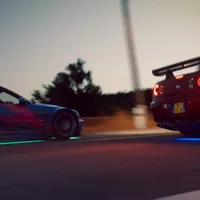
It’s been a long time since we’ve seen a true “game-breaker” in the racing game category.
Of course, this is not to say that there is a lack of excellent racing games on the market today. Whether you want to play in a simulator to “increase full lap speed” or play in an open world to “appreciate the scenery”, you still have options. But for me personally, when talking about racing games with friends, I can still think of the shocking experience of playing “Need for Speed: Most Wanted” when I was a child. It was dangerous and exciting, and playing the game was like watching a movie.
When talking to Mike Brown and Ben Penrose about this, they also smiled knowingly.
Let me introduce them first. They are the former creative director (Mike Brown) and art director (Ben Penrose) of the “Forza Horizon” series. Now, they have formed a new Maverick Games studio with about 40 former veterans of Playground Games, as well as developers from classic racing games such as “Driving Club” and “MotorStorm”, and brought their ambitious work – “CLUTCH” (Chinese name: “Clutch: Red Line”, hereafter referred to as “CLUTCH”)。
During the National Day holiday in Little Red Book Redland, Ji He met Mike and Ben on Fuxing Island and had an exclusive interview with them after trying out “CLUTCH”. During the interview, Mike and Ben opened up about their reasons for leaving Playground, as well as the ambitions and breakthroughs they wanted to achieve in “CLUTCH”.
They are not shy about exploring opportunities. At least in their eyes, the next place where “car culture” will explode is China.
Note: This interview is organized/coordinated by DENMU Edition. DENMU Editions is the marketing and co-issuing department of the investment fund DENMU. In China, it serves as the coordinator and local interface of the CLUTCH team, providing assistance and design support for its REDLAND booth, and is responsible for its liaison with local Chinese media. DENMU Editions has previously provided similar services in China for other titles, such as Kazuki Kodaka’s “100 Days War – Final Defense Academy”.
Why don’t you leave the already successful “Horizon” series behind and have to stand out on your own? This is the first question I asked, and it is obviously a question that many players are concerned about.
Mike’s answer is actually very simple: when a business formula achieves great success, capital and business operations no longer allow you to take any risks. “They just want you to do the same thing over and over again.” This “curse of success” means depletion of motivation and boredom for creators.
The two “industry veterans” actually did not intend to disparage the game they once loved deeply. It is just that due to the changes in the deeper business model, the time for their own “desire for change” has arrived. In the “Horizon” series, an already successful IP, and in a model where XGP is an important source of players, the core indicator for measuring the commercial value of the game has become “the total playing time of players.”
When the ultimate goal of game design becomes “how to keep players in the game as long as possible,” those truly disruptive and exciting new ideas are often replaced by solid “brush” mechanisms. This is one of their core frustrations.
“CLUTCH” may be regarded as a product of a “repressive environment”.
The goal of the Maverick Games studio is to create an immersive story racing game that does not pursue hundreds of hours of aimless play. In the words of the creators, they want to use a deep stand-alone immersive story to reawaken players’ original desire for the “danger and excitement” of racing.
In order to tell this story well, “CLUTCH” has made a setting that is rarely seen in today’s racing games: it abandons player-customized faces and adopts a fixed dual protagonist setting – brother and sister Theo and Cass.
Players who are used to being themselves may feel uncomfortable, but if you know who the chief screenwriter of this game is, this doubt will probably be dispelled in an instant – Jamie Brittain, the screenwriter of the classic British youth drama “Skins”.
This is his first foray into the gaming world. “Skins” is famous for depicting young people’s rebellious, chaotic, delicate and extremely destructive emotional relationships. I am personally an old fan of “Skins”. More importantly, if I think about it carefully, the characteristics of this show are a perfect match for “street racing stories”.
Mike and Ben believe that if you want to tell a story that is deep enough and full of tension, the setting that “the protagonist can be anyone” will make the narrative thin. The complex family bond between brothers and sisters that can support each other, but also hurt each other and make fun of each other is the core driving force that drives the plot forward.
This tension is also reflected in the world view setting of the game. “CLUTCH” constructs a “double-sided world” with a strong sense of conflict: one side is the century-old and glorious R1K professional championship; the other side is more secretive and focuses more on self-expression.[XF1] the entire underground street circle Midnight Collective is broadcast live online.
During the short game trial, players experienced the championship (racing mode) and chase (story mode) respectively. The creator said that a respected professional driver became a “getaway driver” in the dark. This dual identity is the core of the drama that the screenwriting team wants to present to the players.
If the plot is the skeleton of “CLUTCH”, then the unique vehicle customization system will still be its soul.
The modification of traditional racing games often pursues a “showroom quality” – the car paint is always shiny and the interior is spotless. But Ben brought up a very fascinating concept during the interview: “lived-in feel”.
In “CLUTCH”, you can decide how dirty the car is and whether there is dust on the dashboard; you can hang an air freshener on the rearview mirror, and you can even throw the dirty clothes you just took off on the passenger seat. The car is no longer a cold racing tool, but your mobile shelter in the chaotic streets and an extension of your personal living space.
Behind this design is a profound insight into the evolution of automobile culture. In Mike’s understanding of car culture, the development of cars in human society has gone through three stages: from a pure “utility tool” to a “luxury product” that demonstrates identity, and will eventually become a carrier of “self-expression”.
In order to encourage this kind of self-expression, “CLUTCH” introduced an unprecedented reward mechanism in the Midnight Collective competition: “creativity and competition ranking are equally important (being rewarded equally for both creative flair and finishing position).”
In this event, as long as your driving style is gorgeous enough, as long as your car is modified to be personalized enough, even if you are not driving the fastest top supercar, the audience in the live broadcast room will still vote for you, allowing you to receive generous rewards equivalent to the championship. Here, personality is more respected than horsepower. [XF2]
In addition to being plot-driven, “CLUTCH” also makes a bold attempt in gameplay: 3v3vAI PvPvE “robotic mode”. [XF3]
Imagine this scenario: Two teams of players infiltrate a grand manor party with the goal of stealing the ultimate red wine before the wealthy man destroys it. Everyone can only drive slow vehicles at the beginning, and need to search for powerful cars with special technology modules in the venue. When you grab the red wine, you not only have to face the crazy collision and snatching from another team of players, but you also have to deal with the chasing AI security team.
The most interesting thing is that the AI in this mode are not just background boards – they can actually win.
If the player team performs too poorly and the security team successfully escorts the items back to the safe area, the AI will win the game. This uncontrollable “unscripted chaos” makes every game full of drama and screams.
In general, “CLUTCH” is not trying to recreate “Horizon”, it is more like a veteran who returns with passion and rebellious spirit in an extremely mature category.
Although jokingly speaking, the word veteran has had mixed reviews over the years, with both good and bad works, but after the interview, I still have confidence in “CLUTCH” at least at this stage.
Game cores (WeChat public account id: Gamecores)
Mike Brown(Founder and creative director of Maverick Games, former creative director of the “Forza Horizon” series, pictured below, left)
Ben Penrose(Art director of Maverick Games, involved in the development of Forza Horizon 1-5, pictured below, right)
Machine Core: Let’s first talk about the opportunity to leave the “Forza Horizon” series development company (Playground Games). What prompted you to establish Maverick Games as a new studio and decide to continue making a racing game?
Ben:I have been on the team since the first generation of “Horizon”, from concept artist to art director, and participated in the development of generations 1 to 5. The main motivation for leaving was to do something different.
The new team we have assembled includes many people, including Mike, who are passionate about continuing to innovate in the racing category in which we have already excelled. As Mike always says, we want to do things that simply can’t be done within the framework of Horizon.
Mike:I joined from Horizon 2, first as a senior designer and then as the series’ creative director. We had a great time there and made a lot of great stuff. But when you’re in a creative industry and want to try something new, you often encounter a “curse of success.”
When a game becomes extremely successful, the business side doesn’t want you to be creative anymore. They just want you to do the same thing over and over again without taking any risks. It’s very unmotivating for us creators, and if you don’t keep moving forward and make new stuff, you run the risk of becoming bored. Rather than staying in a safe zone where innovation is not required, we would rather go out and form the best team ourselves and do some new attempts that have never been done before in the category.
Machine core: This next question may be a little bit sensitive. In the eyes of many players, the current version of “Forza” does move towards a sustainable operation (GaaS) perspective. Is this also the core reason why you want to leave and use “CLUTCH” to make a single-player, immersive story experience game?
Mike:Regarding the micro-transactions in “Forza”, in fact, its commercial proportion in this aspect is not as large as everyone thinks. Its business model is more driven by Game Pass.
In the Game Pass mode, the standard for studios to make money is based on the “total play time” of players. So the driving force of game design is to keep players playing, not the microtransactions themselves. But this is not actually the core reason that hinders our creativity. At that time, Game Pass was the focus of Microsoft, and we did optimize the design for it.
What really makes us feel restricted is what I said before – when you have an extremely successful business formula, your willingness to change it will become extremely low, because business does not allow you to take risks.
Ben: I totally agree. When developing the first few generations, there was a real energy and excitement within the team because we were creating something completely new.
Once a formula is finalized and successful, the desire to change it becomes very low. It’s a smart business decision, but as creators, we’re eager to get back to the kind of creative environment that inspires exciting ideas.
Machine core: To be honest, I am not a die-hard fan of “racing games”. The one that impressed me most was probably “Need for Speed 9” when I was a kid.
During the trial play just now, I also felt that this game has some intention of going in that direction. Now the NFS IP may have entered its era, and neither Forza nor GT are games of this type. Have you taken a fancy to this market gap?
Mike:I personally am not a hardcore racing simulation fan, but I have played many such games, such as “Forza 4”, “Forza 5”, and GT on PlayStation, etc. But my favorite racing game with a plot setting is also “Need for Speed 9”. You felt a similar vibe while watching “CLUTCH” today, and you’re right. It can be said that NFS is not as influential as it used to be.
When we were thinking about CLUTCH, we looked at the biggest hits in the genre: Forza Horizon, The Crew, Need for Speed. We wanted to design a game that stood alongside them, but also had its own space. When you get into a new game, you expect familiar elements but also crave a new experience.
It’s clear that there are currently no new, in-depth games of this type on the market. NFS has not had a new game for a while, and a large number of players may not have played a new “story-based racing game” in four or five years. The market is very hungry for such games.
Therefore, we will meet the needs of these players in terms of customized modifications, deeper stories, and a higher sense of crisis (High stakes).
JiHe: Can you tell us how many people there are in the studio now? What is the makeup of the team? For example, if the person in charge comes from Forza, what is the composition of the writing team and art team?
Mike:We currently have 140 people. The early team did have a lot of familiar faces that we had worked with before, and about 40 of the 140 people had worked on Forza before.
In addition to that, there are some developers that I’ve worked with at Sony before on Driveclub and MotorStorm, and people who worked on Project Gotham Racing and so on. So in the field of racing games, we have a very deep foundation. At the same time, there are also many talented young people in the team.
Ben:The same is true for the art team. Not only do we have excellent old colleagues who have worked together at Playground, but we also discovered many talented newcomers.
As for the writing team, we have recruited some talents from outside the game industry, such as writers from the television and film industries. Our chief writer, Jamie Brittain, is entering the gaming field for the first time, but he was previously a writer on the very famous British youth drama “Skins”. He is very good at creating characters that are interesting, fleshed out, three-dimensional and have depth.
Core: Back to the game content. When I saw the introduction just now, I was particularly interested in the setting of the “double-sided world”: there is the century-old R1K professional competition during the day, and the underground Midnight Collective street competition at night. Was this setting there from the beginning?
Mike:Yes, this idea came to me very early on. When you consider that a respected professional race car driver turned out to be a “getaway driver,” this conflict of dual identities is extremely compelling in its own right.
In the setting, R1K is a professional racing sport with a century-old history and high reputation, which is very professional and serious. The Midnight Collective is an underground circle purely composed of a group of people who love cars. They just want to drive their cars out to have fun with their friends and show off to each other. This part of the competition will even be broadcast live in the game world.
We hope that through these two completely different events, players can experience two completely opposite driving atmospheres in an open world.
Machine core: There are fixed protagonists of brother and sister in the game, and most of the current racing games allow players to customize the protagonists. How did you consider the setting of a fixed protagonist? Do you want to rely on traditional action narrative games?
Mike:Today’s games do tend to let players customize their appearance so they can immerse themselves in it. But if we want to tell a deep story, if the protagonist can be “anyone,” then the narrative becomes very difficult and thin.
In order for a story to be engaging enough, the characters must have a clear and solid setting. The addition of the role of Cass (sister) is very crucial. If you have siblings, you know how fun this dynamic can be—you can support each other, but you can also mess around and joke around.
This kind of deep family emotional bond is simply impossible to achieve with a “blank slate” player character. In addition, we designed some high-speed missions with narrative goals in the story. In these missions, the interaction between brother and sister will make the entire experience full of tension.
Machine core: Car modification is also an important part of racing games. To what extent will the specific modification and creativity be achieved?
Ben:In addition to the obvious regular modifications like paint changes, decals, wheels and body kits, we wanted to go to an unprecedented depth of detail.
We have added a setting called “lived-in feel” to the game. Your car isn’t just a shiny model in the showroom, you get to decide how dirty it is inside and whether there’s dust on the dashboard. You can hang an air freshener in your car or even throw your clothes on the passenger seat. Likewise, you can swap out different racing seats, custom steering wheels, and shifters. We want to give players a real, personal sense of “ownership” of their car.
Ji He: I noticed a sentence in the introductory information, “being rewarded equally for both creative flair and finishing position”. How does this reward system work, which depends not only on finishing position but also on creativity?
Mike:In the traditional professional game “R1K”, which is a sport, your goal is of course to strive for first place. But in the underground circle of Midnight Collective, your driving process is broadcast live. Your main goal is to impress the audience in front of the screen, and that doesn’t necessarily mean you have to be out front.
Ideally, you combine the two: you get a good ranking and your driving style is very flashy and handsome. As long as you show your personality and creativity, the audience will vote for you and you will still be the winner in the end. Car culture is changing from a purely practical tool and luxury product to a way of “self-expression”. So even if you are not driving the fastest or most expensive top-level supercar in the game, as long as you put your efforts into it, you can still get a great sense of accomplishment in the game and the same rewards from the system.
Machine core: Let’s talk about the PvPvE gameplay. It is quite special among racing games. When I tried the game just now, I saw a scene where the police came in, and the press release also mentioned “shifting alliances” and “unscripted chaos.” How do these work specifically?
Mike:We’ve talked before about how there will be “high-speed escape” missions in the story mode, such as infiltrating a grand manor party and stealing the world’s most expensive wine before the party host destroys it.
PvPvE is the multiplayer version of this story mission. In this mode, it is no longer a single player experience, but is divided into two teams, each team has 3 players, and both teams are trying to sneak in and seize valuables. At the same time, the police and security teams will also intervene as AI forces to try to stop the player team.
For example, if I grab that case of wine, other players will try to bump into me, causing me to drop items, and then they can grab the wine. And the AI security team keeps bumping into me. It’s called PvPvE because the security team (AI) can actually win! If they put the item into their safe zone, the AI team will win the game if both player teams perform poorly and cannot take it back.
As for the “chaos” you mentioned, this model can indeed be extremely chaotic. In the multiplayer mode, all players start with very slow cars, and then you can search and discover other better cars in the field. Some of them are even equipped with CLUTCH’s special technology modules, which can provide additional abilities.
The game swings like a pendulum between the parties at any time, making it very chaotic to play, with everyone in the office often laughing and screaming while playing.
Regarding “changing alliances,” this doesn’t actually mean that you can ally with a specific NPC. Rather, as the story progresses, as part of the R1K or Midnight Collective storyline, the alliance relationship will shift and change, but this is not necessarily a setting that is freely controlled by the player.
Jihe: I very much agree with the point you mentioned before that “car culture is developing.” The same is true in China. For example, F1 events are becoming more and more popular in China, especially young women, which have become a new growth point. What do you think of the development of car culture in China and the opportunities for racing games in this?
Mike:I think you’re going to see this deeper shift very soon. When a country’s culture first comes into contact with cars, cars are initially purely “utility.” At a certain stage of development, it will transform into “luxury”, which is not only purely practical, but also to demonstrate status. After that, the car will become a tool for “expression of self.”
I think China’s current car culture may be in the “luxury” stage. Buying a good car is to show your status. But I believe you will soon see people want to cross this stage from simply displaying luxury to expressing themselves and wanting to customize it themselves.
This is the idea we want to convey in the game: a car may not be the fastest, it may not be the most expensive, and it may not be the latest, but it shows who you are and it is your favorite car. We feel that this is also a journey that people who love cars all over the world are going through together.