source:Slightly larger for reference
Original title: “Huawei took away the soul of the car company and also took away the infamy”
Author|Yang Zhichao
In just one month, there have been some problems in two of Hongmeng Zhixing’s five realms.First, Sailis took away the dominance of Wenjie, and then the brake pedal of Zunjie broke.
Any car company will have product quality issues, but one problem that other car companies will not have is: Huawei, a “smart supplier” that does not produce brake pedals, and the entire car-making model have been questioned a lot, and four of the five industries have seen their stock prices fall on the same trading day.
The unique troubles, of course, come from Hongmeng Zhixing’s unique business model.
1. Take away the soul and also take away the infamy
In 2023, Huawei staged a public internal battle.
The protagonists are Yu Chengdong and Xu Zhijun, who have differences over Huawei’s automotive business.
Yu Chengdong believes that Wenjie’s smart car selection model is difficult to replicate because many car companies are unwilling to hand over core parts to Huawei. If Huawei gets involved more deeply, it can maximizeRealize the Huawei brand。
And represented by Xu Zhijun“The faction that doesn’t build cars”I believe that Huawei wants to be the service provider behind the main engine factory, similar to Qualcomm in mobile phones and CATL in electric vehicles. This is a more promising role.
Differences in business forms are not about the right people but the matter. It is a benign internal conflict and there is nothing to hide. Therefore, the whole process is completely on the stage, almost “live broadcast on the whole network”.
The core manifestation of the differences is that the word “Huawei” has begun to appear frequently in the promotional materials of the industry.
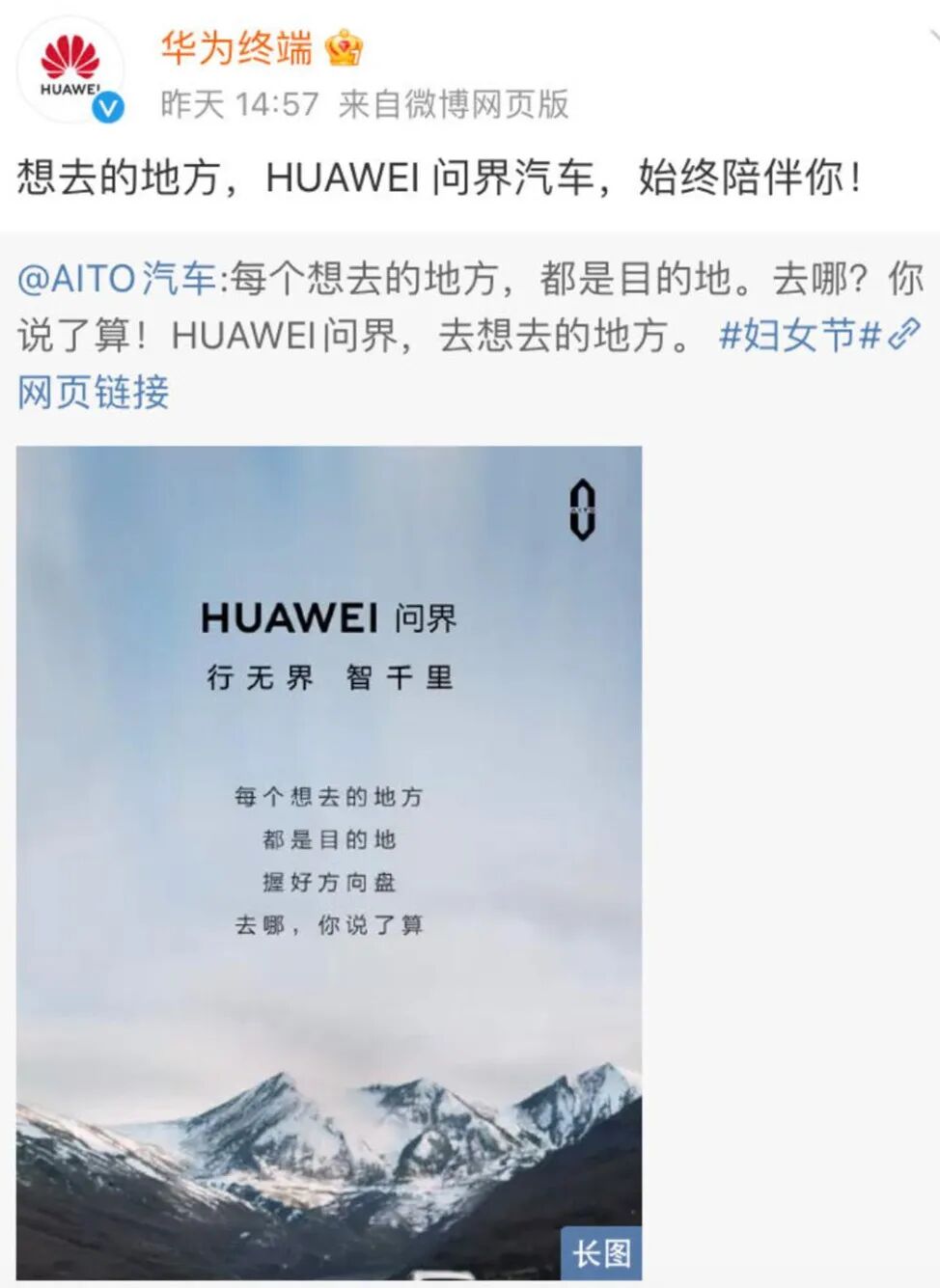
Later, Xu Zhijun publicly stated: “Recently, it is true that some of our departments, or some individuals (Yu Chengdong was not named), or some partners have been abusing Huawei’s brand.”
After his speech, Wenjie quickly changed direction, and the word “Huawei” disappeared again from Wenjie’s promotional materials. After the Huawei Wenjie brand was removed, Huawei Smart Car Selection (Hongmeng Zhixing) was very successful. More and more car companies took the initiative to donate their so-called “souls”, and the sales of the entire Hongmeng Zhixing were also booming.
But does this mean that the word “Huawei” is chosen correctly?
Maybe there is no right or wrong at all, because facts have proven that in some cases, it makes no difference whether to pick it or not.
At least after the brake pedal breaks, consumers will still more or less point the finger at Huawei.
Why did Zunjie’s brake pedal break? Who is responsible? Whether it can be purchased from a certain brand? These questions are left to car reviewers, technical experts, authoritative departments, car enthusiasts, and brand fans.
What we want to discuss here is: Huawei’s smart car selection model makes Huawei very unhappy. If there is a problem with any car, it will affect the value of the entire Hongmeng Zhixing ecosystem.
At present, Hongmeng Zhixing has more than15cars, total sum5cooperation with traditional car companies.
As the “car-making faction” fails in disagreements in 2023, no car among them has the word Huawei in its name.
Even the name of the ecosystem “Huawei Smart Car Selection” was changed to “Hongmeng Smart”, further weakening the existence of the word Huawei.
But the secretary does not mention the leader when he goes out. Everyone knows that he represents the leader.
October 8th,Jianghuai AutomobileShare price due to brake pedal breakage incidentDropped 10%. On the same trading day, BAIC Blue Valley alsoDropped nearly 6%. Chery also fellMore than 3%Thalys (Hong Kong stocks)down 6.7%。
Logically speaking, the brake pedal is not part of Huawei’s core empowerment part. Huawei is responsible for the “brain” part. The problem of the brake pedal should not affect the entire Hongmeng ecosystem.
Just like Ideal and NIO both use batteries from CATL, if one of them generates public opinion due to non-battery reasons, will the stock price of the other company fall?
But everyone knows that this is just a superficial statement. Whose brand is a car on, whose name is the sales statistics, what is the name of the business model, and what Huawei calls its own role? These are just formalities.
What really matters is not the form, but who are consumers buying this car for?
From Yu Chengdong putting up the Huawei brand to Xu Zhijun publicly criticizing “individuals for abusing the Huawei brand”, these are just changes in appearance. And “Li Zi” is obvious:Consumers buy Zunjie not because of JAC, but because they believe in Huawei. There is no Huawei in their name, but from beginning to end, the word Huawei is the core, and Huawei has also made huge profits.
There is no free lunch, and Huawei has to bear the reputation problem of any car.
Yu Chengdong also said in 2023: We are leading the smart car selection because we are selling, and customers will find us if they have any problems, so we must be responsible for the user experience.
But how can it be so easy to manage so many different car companies and so many product lines?
There is a view that there is a risk when Xiaomi builds cars. Because if there is a problem with the mobile phone, it is nothing more than lag, and at most it is information security. But cars are products that are prone to accidents and fires. It is impossible for any car company in the world to guarantee that there will not be several fatalities in its cars.
Once a car has a problem, it will affect the credibility of Xiaomi’s huge product line. This is a huge risk – this risk has been verified. After Xiaomi’s car caught fire, Xiaomi’s mobile phone business, Xiaomi’s stock price, and even Lei Jun’s own Douyin fans all experienced fluctuations.
According to this logic, Huawei’s risks are even greater: Huawei has five brands of cars, and any problem with any one of them may affect the entire ecosystem.
2. Get rid of the burden and also get rid of some benefits
The logic of “Huawei does not build cars” has never been difficult to understand: when cutting the cake, you have to cut the sweetest part.But while “eating the best cake”, Huawei may also get something less.
In fact, not only does Huawei not make cars, Intel does not make computers, and Nvidia does not make game graphics cards (it only makes GPU cores), because CPUs and GPUs are high-profit businesses, and digital products are low-profit and high-risk businesses.
Of course, low profits are also profits, and no company would be dissatisfied with having too much money. But the problem is that the ability to make CPUs well is far from the ability to make computers well. If a CPU company ends up making computers, if it doesn’t do well, it will lose a lot of heavy capital investment. If you do it well, you will become a competitor to your customers and reduce your customer scope.
Xu Zhijun once expressed an idea, to the effect that no matter how good Huawei’s cars are, it will only get a small share. But empowerment can empower the entire industry.
There is certainly basis for this statement. Intel does not make computers, but most computer manufacturers have to pay it. CATL does not build cars, but most car companies still have to pay for it. If you can make an “operating system”, of course no one wants to make a product.
But we cannot simply understand Hongmeng Zhixing as CATL or Bosch. Their business models are completely different.
Smart Car’s involvement is too deep and goes far beyond the scope of suppliers. CATL can get 50% of the share because it only produces battery hardware. No matter how high the unit price is, it does not define the car.In the Hongmeng Smart Travel model, Huawei directly defines the main parts of a car.
It is indeed impossible for car companies to occupy 50% of the market share like suppliers, but can Hongmeng’s ecosystem be enough? At least so far, it’s still far, far away. In September this year, Hongmeng Zhixing’s total delivery volume was less than 40,000 units. This is still a “car company” level, not an “operating system” level.
Of course, even if it cannot expand the market scope, this model also brings high gross profits.Because Huawei assumes the two most profitable parts of the “smile curve”——designandbrand。
But everything has a price. Why does Apple not only manufacture the operating system, but the entire mobile phone? It even spends money to help suppliers modify the production lines and intervene in many heavy asset parts?
Because asset-light has the benefits of being asset-light, but it also loses something. For Hongmeng Zhixing,
-
One is to manage relationships with partners.
This is the second worry that Hongmeng Zhixing is currently facing besides the brake pedal incident: Wenjie is about to move.
In September, both parties issued a statement at the same time. From then on, the product definition, design and development, brand marketing, channel retail, and user services of Wenjie will all be led by Cyrus, while Huawei will retreat behind the scenes to provide technical empowerment.
Yu Chengdong later revealed in an offline event that “Wenjie proposed that they do it themselves, and we support them.” In addition, the “Five Worlds” troubles include the problem that the new model of Zhijie in September coincided with the positioning of Wenjie.
There is no need to list them one by one. In short, when there are several car companies behind a brand, it is very difficult to have very little trouble.
-
Second, the extremely valuable brand “Huawei” has not been monetized thoroughly enough.
Hongmeng Zhixing represents Huawei, but after all, it is worse than using the word “Huawei” directly. The salesperson saying “this car is made by Hongmeng Ecosystem” is worse than “this car is made by Huawei”.
Yu Chengdong also said in 2023 that (with the word Huawei) it can avoid confusing consumers.
-
Third, it is the loss of 100% control over the product.
This Zunjie brake pedal breakage, could it have been avoided if Huawei had built the entire car? No one knows, but at least similar product problems have not been reported in other industries.
Of course Huawei has the obligation to control product quality – but managing others is ultimately more difficult than managing ourselves.
Has this “not building a car” business model made Huawei more money?
Maybe it makes a little more money. After all, Huawei does not have to get involved in the relatively low-profit production part and can receive high-quality technical service fees.
But perhaps, Huawei also made less money because of this.
3. Unique mode, unique twist
Any business model has its shortcomings. The purpose of this article is not to find out the shortcomings of Hongmeng Zhixing. This is meaningless. But I want to express: Hongmeng Zhixing’s troubles are unique and cannot be found in most other car companies.
Does Intel need to consider competing for market share among its customers and help them position themselves in different markets to avoid internal friction?
No need, Lenovo and Dell can fight as much as they like, even if one is beaten to death by the other, it has nothing to do with Intel.
Does Qualcomm need to bear the pressure of public opinion for the quality of customers’ mobile phones?
No, as long as it is not a problem with the chip itself, even if a customer’s mobile phone explodes and destroys a building, it will not affect the credibility of Qualcomm chips at all.
But in the case of Hongmeng, the brake pedal broke, which affected Huawei.
Ultimately, Huawei Smart Car Selection (Hongmeng Smart) is an almost unique business model in the world.
But another question behind being unique is: why don’t others do it? Why don’t others become Intel, Google, and Microsoft in the automotive industry? Is it possible that the automotive industry does not need an “operating system” role?
The answer is at least dubious.
After all, cars are not electronic products. Computers and mobile phones have a huge software ecosystem and need a “platform” to provide unified application standards. If each company uses different chips, different instruction sets, and different operating systems, the development of any app will be a disaster.
But there is no such a huge and unified software ecosystem in cars.
Perhaps because of this, in the era of fuel vehicles, the automotive industry does not have its own Intel, Nvidia, or Microsoft. In the tram era, this role was stillDidn’t show up yet
—— Intelligent driving companies such as Momenta are not included. Its market share is not that big. Most of the market is occupied by self-developed systems of car companies.
Qualcomm is not included. Although their share is high, the car chip accounts for too little of the value of the entire car and is not a core component at all. When consumers buy a car, they first look at the battery life, size, and comfort features. Who would look at the car chip first?
The fact is that the role of “ecological founder” who can empower many car companies and make more money than building cars itself is difficult to find in the car market.
Companies are only suppliers with supporting roles, rather than ecological protagonists such as Hongmeng Zhixing, Intel, Microsoft, and Google.
However, for Huawei, it may not be a good choice to become a supplier like Bosch and Momenta.
Because for Huawei and its customers, the place where Huawei creates the greatest value for its partners is not only technological empowerment, but also the value of the brand.
It cannot be said that Huawei’s smart cockpits, smart driving systems, and three-electric systems are not scarce. After all, Jihu, Avita, and even Audi and BYD have purchased Huawei’s technology. This is obviously because Huawei’s technology is powerful and can bring value to car companies.
But in the Chinese market, compared to smart driving technology and smart cockpit technology, what is more scarce must be the endorsement of the Huawei brand.
Momenta and Horizon also have smart driving software, which has been verified by a large number of domestic and foreign luxury brands. Honeycomb and Fudi can also provide three-electricity systems, and already have many successful products.
But with the endorsement of “Huawei’s deep involvement”, this is an almost unique service. No business is for sale.
This means that if you want to maximize the value of Huawei, you must be deeply involved. And when Huawei is deeply involved, “whether Huawei can build cars or not” is a meaningless debate.
Regardless of whether it bears the Huawei brand or not, Huawei has in fact “made cars.” There is no Huawei in the name of Wujie, but they are in fact Huawei-branded cars.
In this case, Huawei has actually shouldered some of the disadvantages of building a car—for example, if there is a problem with the car, Huawei will still have to pay for its partners.
Author’s public account: slightly larger reference (ID: hyzibenlun)

For more exciting content, please visit Shuying.com – Article Channel – Project Channel – Recruitment Channel