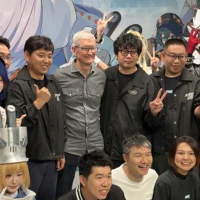
On the afternoon of October 16, Tim Cook came to miHoYo’s Shanghai headquarters.
The Apple executive chairman stayed here for about 30 minutes and was received by MiHoYo co-founder Liu Wei (Big Viagra). According to on-site information, Cook experienced the optimized performance of “Zero” on Apple’s first foldable screen mobile phone iPhone Duo, and also learned about two other new games being developed by miHoYo: “Starbuck Valley” and “Honkai: Karma Elves”.
As one of the media invited to witness this visit, this is my second close encounter with Tim Cook. Many people are accustomed to placing him under the halo of Jobs and regarded him as a legendary successor. But judging from the results, Cook not only took over the huge business empire left by Jobs, but also pushed Apple’s market value to new heights. Based on this alone, what he has accomplished is beyond the reach of most people.
If Jobs is a genius who is good at defining products and changing people’s imagination, then Cook’s genius may be more reflected in the other side: he knows how to keep a company running, and how to turn an already great thing into a larger and longer-lasting business. The abilities of the two people may not be easily comparable, but at least in my opinion, Cook is obviously not just a lucky successor.
Even though he is no longer directly responsible for Apple’s daily operations, Cook still bears important responsibilities, which MiHoYo naturally knows very well. Before his official visit, the whole building had already presented a rather subtle atmosphere: tense, but not suffocating. What’s tense is the on-site staff and security, who are all preparing for this visit; and that sense of relaxation comes from a certain familiar temperament of the Apple team—if you’ve ever visited an Apple store, you can probably understand what I’m talking about.
It’s not quite like a formal reception that needs to deliberately emphasize status and class. Instead, it has the feeling that Apple products always give people: natural, friendly, and not too far away. The two completely different states mixed together made the scene look a little special.
At about 2:15 p.m., Cook entered through the main entrance accompanied by Da Viagra. Almost as soon as he appeared, a burst of cheers erupted.
Cook himself is quite nice. He smiled and greeted everyone present, his expression was natural, and he did not deliberately put on airs. At least judging from these few minutes of contact, he didn’t feel like a technology company executive who was receiving the spotlight, but more like an ordinary person who was used to such occasions and was willing to respond to the enthusiasm of the scene.
Later, Big Viagra took Cook to visit the company’s wall of honor. In front of a display cabinet full of trophies and honors, he proudly told Cook that MiHoYo has won Apple’s annual iPhone game award twice: one for “Genshin Impact” in 2020, and the other for “Honkai Impact: Star Rail” in 2023.
Talking about these two award-winning experiences, Cook made a joke and asked Big Viagra if he planned to win again next time. Daweiwei barely hesitated and gave an affirmative answer: “We are now preparing to get the third seat.”
As soon as he finished speaking, the scene immediately erupted into cheers and laughter. The originally slightly formal visit process became a bit more relaxed because of this answer. Later, Cook also met a robot dressed as the character “Nalo” from “Star Cuckoo Valley”. Faced with this rather confusing shape, he smiled and said: “I really didn’t realize it was a robot.”
However, more than these relaxing episodes, I am more curious about why Cook came to MiHoYo at this time.
If you just look at the scene, this is nothing more than an exchange between Apple executives and a well-known game company: visit the wall of honor, understand the corporate philosophy, and then take a look at the games under development. But when you put the day’s itinerary into the timeline, you will find a noteworthy detail——October 16th happens to be the day when iPhone Duo starts pre-orders in China.
This gave the whole interview an extra layer of meaning worth pondering. When Apple announced this product in September, it positioned it as a new device that combines portability, large-screen experience, and high performance. When unfolded, it has a 7.6-inch internal screen, equipped with an A20 Pro chip, and uses a specialized heat dissipation design. What’s more noteworthy is that when Apple introduced this new mobile phone, it even directly listed “Zero” as a representative case of large-screen gaming experience.
Of course, this does not mean that Apple and miHoYo have definitely reached any new agreement, nor does it prove that this visit was a carefully arranged business promotion. But at least judging from the timing and content of the presentation, this meeting did not look like a courtesy visit with no specific goals at all.
And I think the most interesting thing about this matter is not the fact that “Cook came to MiHoYo”, but: why does Apple need MiHoYo, and what can MiHoYo get from Apple?
A “real foldable screen game”
A “real foldable screen game”
A real question facing iPhone Duo is: Why is a folding screen necessary?
For a company like Apple that already has a mature product system, launching a new hardware form is not enough to solve engineering problems. Consumers may feel fresh about the larger screen, thinner body, and more sophisticated hinges, but whether this freshness can eventually become a reason to buy still needs to be proven by specific usage scenarios.
Especially the iPhone Duo starts at 15,999 yuan. Faced with such a price, it is obviously not enough to just tell consumers that it can be expanded into a larger screen. What consumers actually want to know more is what this screen can do.
Videos, reading, and multitasking can all be answers, but gaming is perhaps the most intuitive of them all. It requires the equipment to continuously perform real-time calculations and provide instant feedback to the player’s operations; works such as “Zero” that emphasize action and camera performance can also focus on demonstrating the equipment’s capabilities in picture performance and continuous operation.
There are several actual iPhone Duo machines placed in the on-site exhibition hall. When the group arrived at the display area, they were introduced by Zhenyu, the producer of “Zero Zero”, as well as Cross and other development members who were responsible for technical work.
You must know that when “Zero” is launched in 2024, it will already support 120-frame operation and controller operation on Apple devices. By 2025, the team further explored the fine vibration capabilities of the iPhone, allowing players to feel feedback through tactility that cooperates with the picture and sound during combat and some animation performances.
And about iPhone Duo. Cross said the team was excited when they first encountered the phone. What attracts them is not just that the screen has become larger, but that the mobile phone finally has a different form of use. For game developers, this means that the interface, operations and information display that were originally fixed on one screen have the possibility to be redesigned.
So the team began to think about a question: How should the player’s gaming experience be connected when the phone is in two states: folded and unfolded? This question may not sound difficult. After all, the screen has become larger, wouldn’t it be enough to enlarge the game screen? But the development team obviously didn’t intend for Cook to see only such a simple thing.
As the screen unfolded, the picture of “Zero Zero” almost instantly filled the entire inner screen. The most intuitive part of the demonstration is that there is almost no obvious sense of fragmentation in the process of switching from small screen to large screen. It doesn’t feel like simply and crudely stretching the screen and stuffing it into another screen.
Next, the developers showed off another feature closer to everyday use: dragging the browser to the side to open it while retaining the “Zero” screen. Therefore, one side is the running game, and the other side can be used to check strategies and information. When the phone is closed again, the game returns to the external screen, and the whole process does not require the player to bother again. The smooth demonstration made Cook couldn’t help but make a sound of admiration.
For gamers, split-screen is nothing new – you must know that the DS and 3DS turned two screens into a part of the game design. The upper screen is responsible for presenting the main screen, and the lower screen can be used to display maps, organize props, and even complete some special touch operations. The two screens not only add up their area, but the division of labor between them also gives rise to many gameplay methods that are difficult to achieve with a single-screen device.
Of course, iPhone Duo is not a DS, and just because it can be folded, we cannot expect mobile games to immediately replicate the dual-screen handheld experience of the year. The two are very different in hardware structure, operation mode and development environment. But when the screen no longer has only one fixed shape, developers have the opportunity to rethink what information should go where and how players should interact with it.
Although what was displayed on site was still mainly about screen switching, multi-tasking and game adaptation. But they have proven that folding screens can not only enlarge the screen, but also allow players to switch between games and other applications more naturally.
Apple and MiHoYo both need something from each other
Apple and MiHoYo both need something from each other
In fact, as early as March 2023, Cook visited miHoYo’s Shanghai headquarters. At that time, he publicly stated that he was very happy to meet the creators behind “Genshin Impact” and thanked the MiHoYo team for creating an immersive fantasy world for App Store users.
More than three years later, it was not just “Genshin Impact” that appeared in front of Cook again.
If “Zero” is suitable for demonstrating the performance and interactive potential of iPhone Duo, then “Star Cuckoo” and “Honkai: Karma Elf” represent other product directions that MiHoYo is exploring: the former emphasizes life simulation and social interaction, and the latter attempts to combine elf cultivation, adventure and strategic gameplay. The differences between the three works make this display no longer limited to the relationship between one game and a new mobile phone, and also give people the opportunity to observe MiHoYo’s broader product layout.
The relationship between Apple and MiHoYo should not be understood solely from the device adaptation of one game.
For a large gaming company, a diverse product portfolio makes real sense. Different games can attract different users and may have different life cycles and commercialization methods. From this perspective, the MiHoYo that Cook came into contact with is no longer just a developer that relies on a certain hit game to achieve global success, but a company that is still exploring different product directions and trying to continue to expand its content territory.
If Apple wants to maintain close communication with leading game developers, then it naturally makes sense to understand what they are developing and where they plan to take their products in the future. After all, for Apple, being able to understand the development needs of a batch of high-quality games in advance is far more valuable than waiting until the product is launched to solve adaptation problems; for MiHoYo, it can be exposed to new hardware forms earlier and has the opportunity to combine technical support with experience design.
Zooming in further, I found that this visit was not just a matter of two companies. Apple needs game developers, and this has actually been going on for many years. As mobile phone performance gradually enters a relatively mature stage, Apple’s positioning of games is also changing.
On the one hand, games are still one of the most visual showcases of hardware performance. On the other hand, games themselves are also an important type of digital content in the App Store ecosystem, which can provide users with reasons to continue using devices and purchasing digital goods.
A China App Store ecosystem research report released by Apple in October this year showed that the turnover and sales contributed by China’s App Store ecosystem will reach 4 trillion yuan in 2025. It should be noted here that this figure is not Apple’s own revenue, nor does it mean that all 4 trillion yuan comes from games; it also includes a large number of physical goods and service transactions that do not require commissions to be paid to Apple. The report also estimates that the revenue generated by digital goods and services is 149 billion yuan.
This report at least shows that Apple still attaches great importance to Chinese developers and the business ecosystem behind them. For Apple, developers aren’t just responsible for filling the App Store; they’re also creating reasons for people to use Apple devices.
For MiHoYo, Apple is not just a channel for selling games. Devices such as iPhone and iPad provide relatively unified hardware and software environments, and Apple’s graphics technology and development tools can help developers further tap into device performance. With the help of the App Store, games can also more easily reach users in overseas markets. For miHoYo, which already has global operating needs, these are important infrastructures.
Of course, this relationship does not mean that there are no conflicts between the two parties. Developers still need to consider platform sharing, user acquisition costs and multi-platform distribution strategies, and it is impossible to bet their business on a certain hardware manufacturer. Apple also needs to face competition from other platforms, and cannot require all games to be designed around its own device form.
Because of this, I feel that the most valuable aspect of this visit lies in whether the two sides have the opportunity to find a more specific cooperation opportunity. After all, Apple can provide new hardware, and MiHoYo has sufficiently mature and complex game products. If both parties can jointly polish products around the same experience goal, then the significance of cooperation is not just to make a game a promotional window for a new device, but to truly integrate the particularity of the hardware into the game design.
Ideas that were originally limited by screen size, interaction methods and device form may have the opportunity to become new ways of playing, and even in turn affect players’ usage habits of mobile games. If it really comes to this point, what Apple and miHoYo will explore together will no longer be as simple as “how to make the game run better on a new mobile phone.”
Cook spent only about half an hour at miHoYo headquarters. Facing the enthusiastic crowd at the scene, many people raised their mobile phones and rushed to record this rare scene, but he always kept a smile and patiently took photos, shook hands and greeted everyone. Even if there are always people around him, he responds to every enthusiasm naturally.
Apple is such a company. It is not only good at transforming technology into products, but also knows how to make these products enter people’s lives and even become the carrier of certain emotions and culture. Of course, the affinity between people and the success of a product are ultimately two different things – iPhone Duo ultimately needs to rely on the product itself to convince users.
As for whether this visit will leave a clearer signal, I am afraid we will have to wait until the iPhone Duo is officially launched and several new MiHoYo games reveal more information before we can see more clearly. But compared to how long Cook stayed at MiHoYo and what he talked about at the scene, I am more curious about another thing: when the folding screen no longer just makes the screen of the mobile phone larger, but begins to change the presentation method and interaction logic of the game, can developers like MiHoYo really participate in this change?
After all, hardware innovation is only the beginning of the story. Apple can provide new device forms, but ultimately what determines how far this form can go is still the experience developers can create on it.
And this may be the most worthy of our continued attention after Cook’s visit.